Choosing refrigeration for a garage is a different exercise from outfitting a kitchen. Garages swing from near-freezing mornings to oven-like afternoons, and those swings are precisely what standard refrigeration is not built for. A garage ready horizontal refrigerator is engineered to hold safe interior temperatures across a much wider ambient range, which is why the category has moved well beyond weekend mechanics and hobbyists. This guide explains what the "garage ready" claim actually certifies, how horizontal units behave differently from uprights in real garage conditions, and which specifications deserve attention before you buy.
Garage ready is not a decorative label. It is a performance claim tied to a defined ambient operating range — the temperature of the air around the cabinet, not the temperature inside it. A conventional refrigerator is typically designed for conditioned indoor space, roughly 55°F to 110°F. A garage ready unit extends that window downward, and in many cases upward as well.
Because the ranges are not standardized across every brand, the rated ambient range should be read off the spec sheet rather than assumed from the badge. Some models are rated from 0°F to 110°F; others use a narrower floor of 32°F or 38°F. A unit rated to 38°F is a genuine garage refrigerator, but it is not the right choice for an unheated shop in a northern climate.
In most refrigerators, the thermostat senses the fresh food compartment. When garage air drops below roughly 50°F, that compartment reaches its set point almost immediately, so the compressor stops cycling. The freezer, which loses cold far faster than it gains it, quietly warms up and food begins to thaw. Garage ready models solve this with a supplementary heater near the thermostat, a dedicated garage mode, or a control algorithm that forces the compressor to run on a schedule regardless of the fresh food temperature. The result is that both compartments hold their set points even when the surrounding air is below freezing.
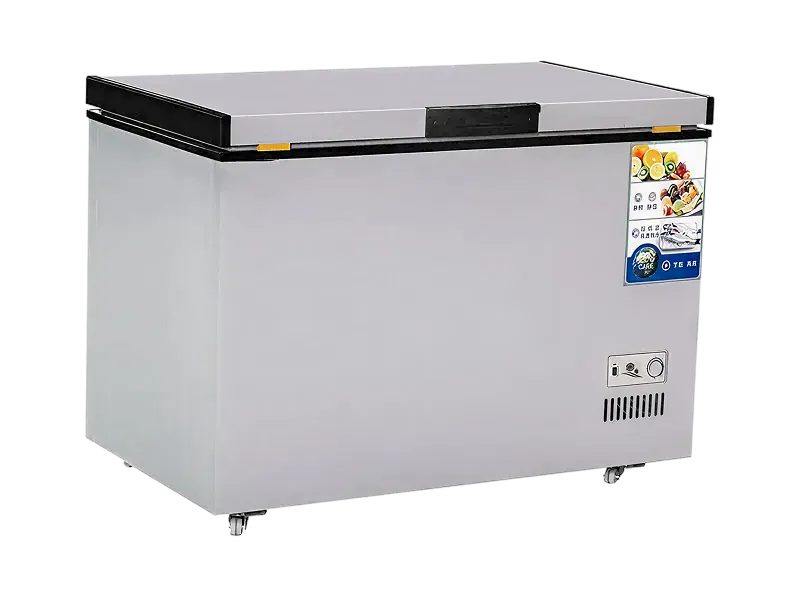
A horizontal refrigerator — a low, wide cabinet with a top-opening lid — addresses three garage realities at once. It sits below the height of a workbench, so it does not compete with wall storage. Its lid opens upward rather than outward, which matters in a tight bay where a swinging door would strike a vehicle. And because cold air settles, a top-opening cabinet loses very little chilled air when it is opened, reducing recovery time and compressor load during hot afternoons.
The failure mode in winter is not mechanical — it is logical. The control system sees a satisfied fresh food compartment and shuts down. Without a heater or a forced cycle, freezer temperatures drift upward for hours at a time. Users often describe this as a refrigerator that "works but doesn't freeze," and it typically appears the first time outdoor temperatures fall below about 50°F.
Heat is a harder problem. A refrigerator rejects heat through its condenser, and the rate of rejection depends on the temperature difference between the condenser and the surrounding air. In a 100°F garage, that difference shrinks, the compressor runs nearly continuously, and interior temperatures creep upward while energy consumption climbs. Inadequate airflow around the cabinet makes this worse. A garage ready unit is built with the condenser capacity, insulation, and airflow design to tolerate this, but it still needs breathing room.
Horizontal units are measured in cubic feet of usable volume, but the usable figure is smaller than the nameplate once interior baskets and the compressor hump are accounted for. For a workshop refrigerator holding drinks, ice, and a few freezer items, a mid-size cabinet is usually sufficient. For bulk freezing or long-term storage, capacity and a reliable low-temperature hold matter more than interior layout.
Placement decisions follow from the same logic. Keep the cabinet out of direct sunlight and away from a south- or west-facing garage door that radiates heat in the afternoon. Avoid enclosing it in a tight cabinet. Leave the published clearance at the rear and sides so the condenser can reject heat, and raise the unit slightly off a concrete floor where standing moisture is a concern.
No. Garage ready refers to ambient temperature tolerance, not weather resistance. Rain, sprinkler overspray, direct sun, and high humidity will damage a unit that is not specifically rated for outdoor installation.
It means it works down to its rated low ambient — commonly 0°F on the best units, but often 32°F or 38°F on entry-level models. Verify the number before purchase if your garage regularly drops below freezing.
In extreme heat, yes. A compressor working against a 100°F ambient runs longer than one in a 70°F kitchen. The trade-off is that the interior stays at a safe temperature instead of drifting.
Field modifications of this kind generally void the manufacturer's warranty and are difficult to validate for safe operation. A unit designed and rated for the application is the more reliable path.
Follow the published figures for the specific model. Where they are not stated, treating rear and side clearance as non-negotiable is the safer approach, especially in a garage that already runs hot.
The distinction between a garage ready horizontal refrigerator and an ordinary one comes down to control logic, condenser capacity, and insulation — not appearance. Buyers who confirm the rated ambient range, verify the warranty covers non-conditioned spaces, and plan for adequate airflow avoid the two most common failure modes: thawed food in winter and warm interiors in summer.
For retailers, distributors, and private-label programs, sourcing matters as much as specification. TZY Kitchenware supplies garage ready refrigeration built around defined ambient ratings, documented clearance requirements, and consistent control behavior across production runs, so the performance claim on the label holds up in the field.
Garage Ready Horizontal Refrigerator for Extreme Temps
2026-10-26Top 10 Questions to Ask Before Buying Your Next Cold Storage System
2026-10-19Blast Freezing vs. Slow Freezing: Which Cold Storage Method Preserves Better?
2026-10-12Why Dual-Compressor Cold Storage Saves Your Budget During Peak Season
2026-10-05Address: China · Shandong Province · Binzhou Detailed Address
Email: tzy@tzykitchenware.com
Phone: +8618754395173

Kitchen equipment
High-performance quality kitchen equipment supplier
Innovative and durable kitchen solutions for chefs and foodservice businesses


Call / Email
+8618754395173
tzy@tzykitchenware.com
Visit Our Office
China · Shandong Province · Binzhou Detailed Address
